






Jeep Grand Cherokee L vs Jeep Wagoneer
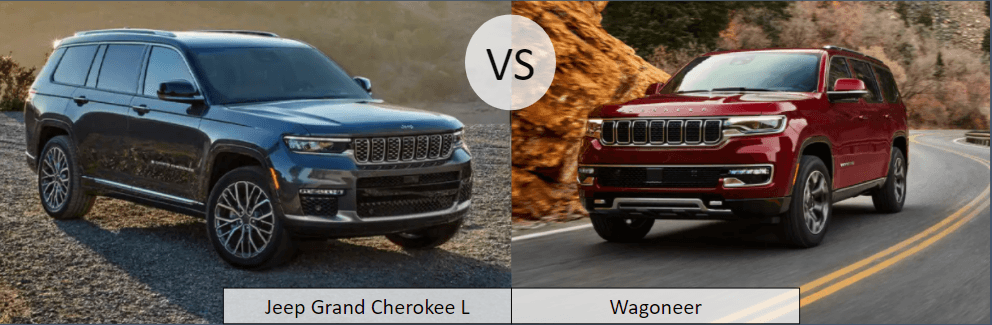
For many people from all walks of life around the world, the name “Jeep” has become a household icon. No matter what country you’re in, what language you speak, there’s no denying that the Jeep brand carries a certain level of respect.
With over 80 years experience, the Jeep brand has grown and developed into something closely resembling the American aspirations of freedom, adventure, authenticity and passion.
Even up to modern times, the Jeep brand has managed to keep up the pace. For this article, we’re going to take a look at a couple of their latest additions to their vehicle lineup, the Jeep Grand Cherokee L and the Jeep Wagoneer.
Whilst both vehicles are born from the same core values that Jeep is founded on, they both have their differences and our aim is show you just how each one differs. In this article, we will be comparing the Grand Cherokee L and the 4×4 Wagoneer Series 2.
Engine/Capability Comparison
This is where you will notice some of the biggest differences between these two vehicles. The Grand Cherokee L features a 3.6 litre V6, that gives you a powerful 290 hp and 250 lb/ft of torque. With its unibody construction and 8-speed automatic transmission, the Grand Cherokee L gives you a max towing capacity of 6,200 lbs. It also offers a combined fuel economy of 22 mpg.
However, if you thought that was powerful – listen to this. In Jeep’s 2022 Wagoneer it boasts a 5.2 litre V8 that outputs 392 hp and 404 lb/ft of torque. This mighty engine under the hood does set the Wagoneer apart from its Cherokee competitor. Due to the larger engine size and torque output, you’re given a max towing capacity of 10,000 lbs. The Wagoneer also features a body on frame design which adds to the vehicle’s overall weight but helps with the SUV’s handling on and off the road. 18 mpg is the given fuel economy of the Wagoneer so don’t stray too far from the fuel station!
Both SUVs come with a Quadra-Trac 1 4×4 system, as the driver this allows you to select from a range of different driving modes including; Rock, sand/mud, snow, auto, and sport mode.
Interior / Technology Comparison
On the inside, the differences become a bit more difficult to tell. Both SUVs feature heated and ventilated front seats with massage capabilities. They both also have 2 captain’s chairs in the second row for that additional passenger comfort. The sound system is also identical as both interiors are built using a 506-Watt Alpine Audio system.
Despite the similarities these vehicles have, there are a few ways in which they differ. For example, the Grand Cherokee L only gives you up to 6 passenger seats. The interior has a nice little feature, however, when driving at night, you have the option to set various colours of ambient lighting inside the cab area, making it that little bit more personalised and comfortable. The Grand Cherokee L gives you 84.6 cubic feet of cargo space with the second and third rows down which is very generous if travelling long distances.
This is where the Wagoneer’s bigger size comes into it’s own however. The body of the Wagoneer is 10 inches wider and 10 inches longer than the Grand Cherokee L which of course offers more space when sat inside. The Wagoneer also gives you a couple of extra seats as it allows 8 people to travel at any one time. This increased size also gives you 116.7 cubic feet of interior cargo volume.
Exterior Comparison
On the outside of these SUVs, much like the interiors, they too are quite similar in the features they offer.
Both the Grand Cherokee L and the Wagoneer provide LED lights all around as standard. Both vehicles offer you the option to upgrade to their Quadra-lift air suspension and panoramic sunroofs. Both also feature rearview cameras and parking sensors – which are a must when trying to park a vehicle this size!
The main difference is the styling and each vehicle’s weight. The Grand Cherokee L weighs in at 6,200 lbs whereas the increased engine and body size gives the Wagoneer a much heavier weight of 7650 lbs.
Price Comparison
Much like the engine size and output, the price also offers you as the consumer some food for thought.
The increased size and power of the Wagoneer does come with a heftier price tag.
Grand Cherokee L – Starting From $39,220
4×4 Wagoneer Series 2 – Starting From $72,440
4×4 Wagoneer Series 3 – Starting From $ 77,440
Conclusion
Jeep has done well to come as far as they have in their vehicle lineup. Both the Grand Cherokee L and the Wagoneer are great cars and live up to the Jeep badge.
Either would be a great option for someone looking for a powerful SUV that would be capable on rougher ground as well as comfortable on a school run. The main differences for a potential buyer to consider would be whether or not the increased towing capacity, engine size and interior space would justify the Wagoneer’s higher price tag. This will be different for everyone depending on your circumstances and what you’re looking for in your next SUV.
It’s also worth noting that there is a Series 3 Wagoneer option that is now available and whilst this vehicle has many of the same features as the Series 2 model, it does offer a few minor differences. Some of these are, automatic high-beam headlamps, third-row power fold and heated rear seats, all of which come as standard on the Series 3 model but are optional extras or unavailable on the Series 2.
Whatever you decide, we hope that this guide has aided you in your decision.
0 comment(s) so far on Jeep Grand Cherokee L vs Jeep Wagoneer